Breed Guide
Ragdoll Colors and Patterns: How to Tell Them Apart
Mitted, bicolor, or colorpoint? Seal or blue? Here is the plain version, with photos of our own kittens.
Breed Guide
Mitted, bicolor, or colorpoint? Seal or blue? Here is the plain version, with photos of our own kittens.
Pattern tells you where the white is. Color tells you what shade the points are. Colorpoint has no white at all, mitted has white feet and a white chin, and bicolor has a white inverted V across the face. Every Ragdoll is born white, and the color arrives over the following weeks.
Almost every family that contacts us asks some version of the same question: what is the difference between mitted and bicolor, and which one should we get? It is a fair question, because breeder websites tend to throw around terms like "seal mitted with a blaze" as though everyone already knows what that means.
Here is the whole system in one sentence: the color tells you what shade the points are, and the pattern tells you where the white is. Everything else is detail.
All Ragdolls are pointed cats, which means the face, ears, legs, and tail are darker than the body. The pattern is about how much white interrupts that.
A colorpoint Ragdoll has a fully colored mask, ears, legs, and tail, with a lighter cream or fawn body. No white paws, no white chin, no white anywhere. This is the pattern closest to a Siamese in layout, though the body type and coat are completely different.
Colorpoints tend to be the most dramatic-looking Ragdolls as adults because there is nothing breaking up the contrast between the pale body and the dark points. They are also the least common of the three in most catteries, ours included.
A mitted Ragdoll has the full colored mask like a colorpoint, but with white "mittens" on the front paws, white boots running up the back legs, a white chin, and a white stripe down the belly. The face stays dark.
Some mitteds also have a blaze, which is a white marking on the face: a stripe, a diamond, an hourglass, or an irregular splash. A blaze does not make a cat bicolor. If the mask is otherwise complete and the feet are white, it is a mitted cat with a blaze.
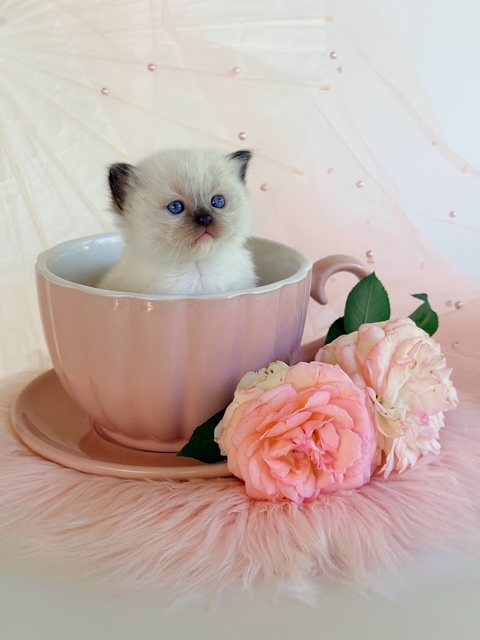
A seal mitted kitten. Note the complete dark mask and the white front paws.
A bicolor Ragdoll has an inverted white V over the nose and between the eyes, white legs, a white belly, and white on the chest. The color is limited to the ears, the outer mask around the eyes, and the tail. The saddle across the back usually shows some color, often quite pale.
Bicolors read as much whiter overall. If you look at a kitten and your first impression is "mostly white cat with a dark mask around the eyes and dark ears," you are almost certainly looking at a bicolor.
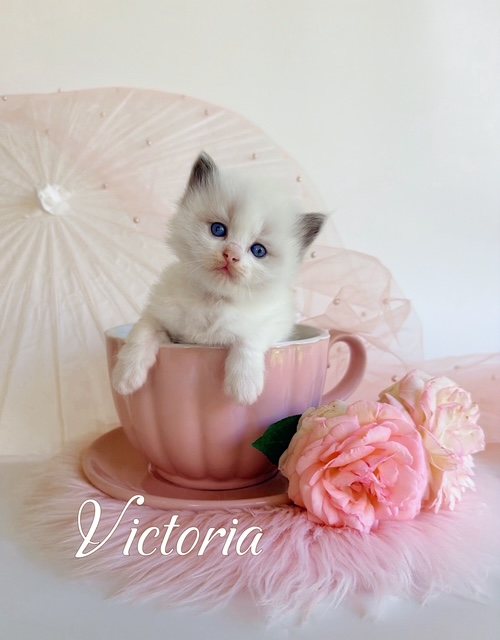
A blue bicolor kitten. The white V and the white legs are the giveaway.
Look at the face, not the feet. Both patterns have white paws, so feet will not settle it. A mitted cat's mask is complete and closed, even if a blaze runs through it. A bicolor's mask is open, split by a white V that reaches down over the nose.
If you are still unsure, look at the front legs. Mitted cats have white that stops at the ankle, like a mitten. Bicolors have white running much further up.
Color is the shade of the points. The two traditional colors, and the two we work with, are seal and blue.
Seal is a warm, deep brown, sometimes almost chocolate at the ears and tail. The body tends toward cream or light fawn. Seal is the highest-contrast option and photographs beautifully.
Blue is not blue in any everyday sense. It is a soft, cool gray, essentially a diluted version of seal. Blue points look slate or dove gray, and the body is a pale bluish-white. Blues are softer and lower contrast than seals, and many people find them more subtle in person than in photos.
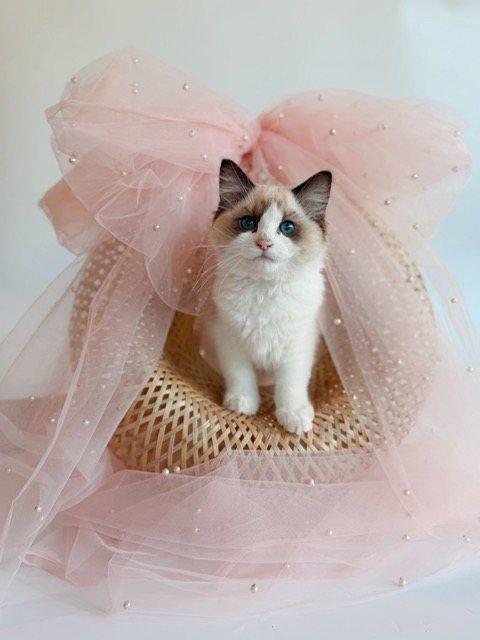
A seal bicolor. Compare the warm brown of the ears against the cool gray of the blue kitten above.
You will also see chocolate, lilac, red, cream, and lynx or tortie variations from some breeders. Those are real Ragdoll colors, but they come from different lines, and we have chosen to stay with the traditional seal and blue.
Color plus pattern is the whole label. Seal mitted. Blue bicolor. Seal bicolor. Blue colorpoint. That is all "seal mitted with a blaze" means: warm brown points, white mittens, complete mask, and a white marking on the face.
Ragdoll kittens come out solid white. The points develop over the following weeks because the pigment depends on temperature, and the cooler extremities are where the color eventually shows.
This has a few practical consequences worth knowing before you fall in love with a photo:
So if you are choosing from photos of very young kittens, ask the breeder what the parents look like as adults. That tells you far more than a three-week-old photo will.
No. We have raised plenty of kittens across all of these patterns and there is no temperament difference that survives contact with reality. The bold one in a litter is bold whether it is mitted or bicolor.
What does affect personality is how a kitten is raised: how much handling it gets, whether it grows up around children and household noise, and whether anyone bothers to socialise it before it leaves. That is worth far more of your attention than coat pattern.
Lilac and cream are the rarest, with chocolate close behind. All three need both parents to carry a recessive gene, which is why few catteries produce them and why they usually cost more when they appear.
We do not breed them. We work in seal and blue, the two traditional colors, because that is where our lines are strongest. Rarity on its own does not make a better cat. A rare color tells you something about the genetics of the parents. It tells you nothing about temperament, health, or what the cat will be like to live with.
Honestly, whichever one you keep looking at. There is no functional difference. Bicolors show dirt less and look brighter in a dark room. Seals photograph with more drama. Blues are calmer to look at and, in our experience, the pattern people choose when they have seen both in person rather than online.
The one piece of advice we would give: if you have a strong preference, get on a list early. Color and pattern are not something a breeder can produce on request, and in any given litter you may only get one or two of what you were hoping for.
Our current kittens include seal and blue, in both mitted and bicolor.
Available kittens Inquire nowRelated reading: what HCM and PKD testing actually rules out and how Ragdolls compare to other breeds.